
Global Manufacturing Automation: Why Adoption Varies Across Regions




Global Manufacturing Automation: Why Adoption Varies Across Regions
Why does manufacturing automation deliver rapid returns in one region yet struggle to scale in another? The answer extends beyond robot prices to labor economics, integration capabilities, infrastructure reliability, and industrial policy. A technically successful installation can still be a disappointing investment if its operating assumptions do not survive local conditions.
Useful global manufacturing automation perspectives therefore start with the factory, not the technology catalogue. The same CNC-tending cell, laser-processing system, or vision-guided robot may solve a persistent bottleneck at one site and introduce expensive complexity at another. Understanding that difference is essential when comparing regional markets, acquisition targets, or production investments.
The economics change before the equipment does
Labor cost matters, but hourly wages are a poor standalone predictor of automation demand. The more useful questions concern shift coverage, turnover, training time, overtime, and the cost of leaving a machine idle. A relatively inexpensive workforce may still be difficult to retain for repetitive night-shift loading. Conversely, a high-wage plant producing irregular, low-volume assemblies may struggle to justify dedicated automation.
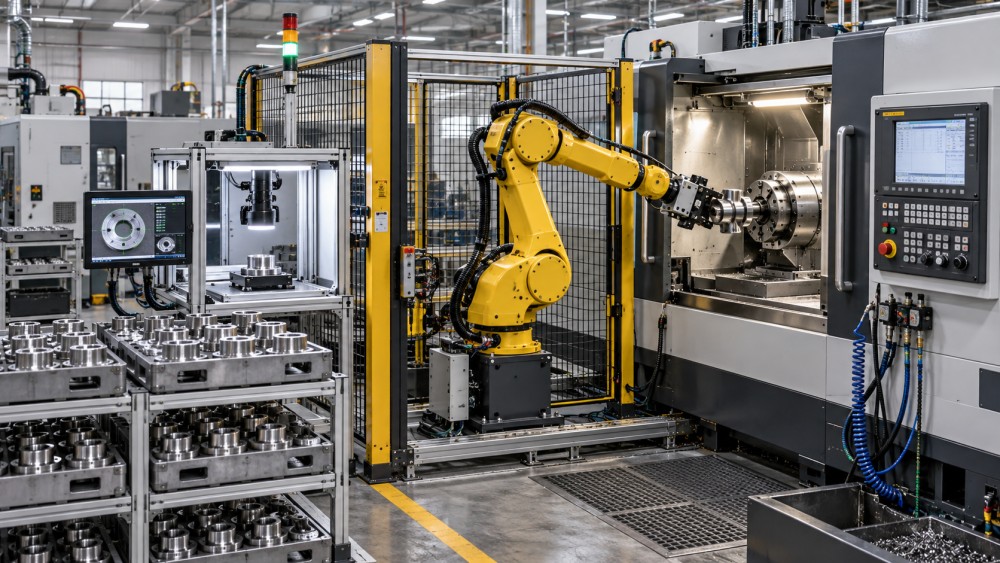
Consider a common CNC application. A robot can load and unload parts reliably, yet unattended production also requires predictable tool life, effective chip evacuation, stable workholding, and a response to out-of-tolerance measurements. If operators routinely compensate for inconsistent incoming material, automating the loading motion does not remove the underlying constraint.
This is why equipment quotations rarely provide a complete regional comparison. Fixtures, guarding, programming, utilities, commissioning, spare parts, and production disruption all belong in the investment model. So does the time needed to reach a stable operating rate—not merely pass an acceptance test.
The strongest business cases usually address a measurable production loss: rejected parts, unfilled shifts, excessive work in progress, or unavailable machine capacity. “Reducing headcount” is often a narrower and less reliable justification.
Regional adoption follows different industrial priorities
East Asia: scale helps, but supplier depth matters just as much
China, Japan, and South Korea should not be treated as one automation market. Their manufacturing structures, equipment supply chains, and investment incentives differ. Nevertheless, established automotive and electronics clusters illustrate an important advantage: proximity to machine builders, component suppliers, tooling specialists, and experienced integrators can make deployment easier to repeat.
In high-throughput electronics production, the commercial value may lie in traceability, inspection consistency, and fast cycle times rather than labor substitution alone. High-precision laser processing and machine vision become more attractive when small defects can compromise an expensive downstream assembly.
The risk is assuming that success in a mature manufacturing cluster transfers automatically to a remote facility. Service coverage, component compatibility, and access to application engineers need separate checks. A locally supported controller platform can be more valuable than a lower purchase price on unfamiliar equipment.
Europe: automation must fit the installed factory
In many European manufacturing settings, the challenge is not building an entirely new automated line. It is connecting mixed-age machinery, preserving process knowledge, and handling product variety within an existing footprint. High-mix production can favor flexible cells, quick-change fixtures, and reliable offline programming over rigid transfer systems.
Safety and conformity requirements also influence engineering scope. A collaborative robot is not automatically a safe collaborative application: tooling, workpiece edges, trapping points, and operating speeds affect the risk assessment. Required safeguards may alter the footprint and cycle time assumed in an early proposal.
Energy consumption deserves a similarly practical review. Evaluating the robot alone misses extraction, compressed air, cooling, and standby equipment. For laser processing or precision machining, the surrounding utilities may materially affect operating economics.
North America: capacity and resilience can outweigh labor savings
Across the United States, Canada, and Mexico, automation decisions often intersect with production relocation, customer delivery requirements, and workforce availability. These drivers differ by industrial corridor and sector; a regional label is not enough to establish an investment case.
For a manufacturer adding domestic capacity, the key benefit may be producing consistently without depending on hard-to-fill shifts. For an automotive supplier, it may be meeting a customer’s quality and traceability requirements. Mexico’s export-oriented clusters introduce another consideration: how imported equipment and components will be supported throughout the asset’s life.
Geography can undermine an otherwise sound proposal. A specialist integrator several hours away may provide excellent installation support but limited emergency response. Evaluators should distinguish remote diagnostics from the physical ability to replace a failed drive, repair a gripper, or restart a damaged cell.
South and Southeast Asia: selective automation can be the stronger choice
India and Southeast Asian manufacturing markets contain both sophisticated export facilities and smaller factories with limited maintenance resources. Lower wage levels in some locations can weaken labor-only payback calculations, but they do not eliminate demand for automated inspection, hazardous-process handling, or precision production.
A staged approach can make more sense than pursuing an unattended line immediately. Automating a difficult inspection station or a repetitive machine-loading task allows the factory to develop maintenance capability while preserving manual recovery options.
Infrastructure checks must remain site-specific. Power quality, compressed-air stability, network coverage, and environmental conditions should be measured rather than inferred from national averages. An advanced industrial park and a smaller inland facility can present very different implementation risks within the same country.
Other markets: industrial clusters are more useful than continental averages
Latin America, the Middle East, and Africa also resist broad generalization. Established automotive operations, food-processing plants, and new industrial projects have different automation needs. Import dependence, financing conditions, and technical-service availability can influence adoption as much as the production process itself.
Where replacement components require lengthy cross-border delivery, local spare-parts holdings become part of the investment—not an optional maintenance expense. Where products change frequently, adaptable tooling may deserve priority over maximum nominal throughput.
The market is moving toward flexibility, but flexibility has a cost
Machine vision, digital twins, and more accessible robot programming are widening the range of tasks manufacturers can consider automating. Their commercial relevance is strongest where they reduce a specific source of deployment effort: locating variable parts, checking reach and collisions, or shortening changeovers.
Still, a flexible robot does not make an entire process flexible. Feeders, grippers, fixtures, inspection recipes, and material presentation must accommodate the product range. A cell advertised as reprogrammable may require substantial mechanical work whenever the part family changes.
Digital twins have a similar boundary. Simulation can expose layout conflicts and test sequences before installation, but its usefulness depends on the accuracy of machine models and process assumptions. It cannot compensate for unknown friction, unstable parts, or undocumented operator interventions.
This makes the “lights-out factory” a destination for selected processes, not a sensible default specification. A resilient partially automated operation may outperform a highly connected line that stops whenever one inspection station loses communication. Recovery behavior deserves as much attention as the demonstration cycle.
Policy changes the calculation—not the process capability
Investment incentives, import duties, export controls, and local-content conditions can change the economics of equipment procurement. Their applicability depends on the equipment, origin, destination, end use, and current rules. Regional policy summaries should therefore lead to transaction-level verification, not substitute for it.
An incentive may improve the initial cash position without solving weak utilization or inadequate technical support. Likewise, a tariff change affecting controllers, reducers, or complete machines can alter supplier choices without changing which process should be automated. Keep these two decisions separate: whether the application is viable, and how best to source it.
Compare deployment readiness, not just market growth
For cross-border investment screening, a short set of operational questions often reveals more than a broad automation-growth forecast:
- What constrains output today? Verify whether automation addresses the bottleneck or merely accelerates an upstream process.
- Which assumptions require validation? Test representative parts, difficult variants, realistic changeovers, and expected material variation.
- Who restores production after a fault? Confirm local skills, escalation arrangements, software access, and critical spare availability.
- Does the case survive lower utilization? Model slower ramp-up, reduced demand, additional maintenance, and delayed product approvals.
- Can the plant recover manually? Establish whether a failed automated station stops all production or allows a controlled fallback.
These questions also help distinguish repeatable automation demand from isolated equipment purchases. A market with strong order announcements but thin integration capacity may offer slower realizable growth than headline investment plans suggest.
GIRA-Matrix’s Strategic Intelligence Center connects robotics, CNC, laser processing, and digital industrial systems with regional supply-chain and commercial analysis. That connection matters because market news becomes decision-useful only when translated into plant-level consequences: component lead times, integration effort, service exposure, and achievable production capability.
Before approving a regional rollout, require one representative application to demonstrate stable production and credible fault recovery under local conditions. Then identify what can genuinely be replicated—and what must be redesigned at the next site. That is a firmer basis for expansion than assuming the same machine will produce the same return everywhere.
Got questions about this industry report or seeking customized analysis for your specific sector? Drop us a line below, and let the research experts at Indu Horizon Report help you out.
We respect your privacy. Your information is strictly confidential.
Related News
- OpenAI Disbands Dedicated Robotics Team, Citing General-Purpose ModelsNov 15, 2026OpenAI disbands its dedicated robotics team but says it is not leaving robotics. Explore how general-purpose models could shape its embodied AI strategy.
- 2026 Automation Conference Highlights Faster Deployment of Embodied AINov 09, 2026Embodied AI deployment takes center stage at the 2026 Automation Conference. Explore what emerging trends could mean for manufacturers, buyers and integrators.
- GS1 US Study Finds AI and Automation Adoption Outpacing Supply Chain Data ReadinessNov 04, 2026GS1 US study reveals AI and automation adoption is outpacing supply chain data readiness. Explore what the gap means for smart manufacturing.