
What Certifications Does Industrial Automation Equipment Need for Export?




Industrial automation equipment does not need one universal export certificate. The required approvals depend on the destination, the machine’s functions, and whether you are shipping a complete system, an unfinished assembly, or individual components. A robot cell accepted in one market may still need electrical changes, additional documentation, or a local inspection before it can operate elsewhere.
So, what certifications should industrial automation equipment have for export? Start with the destination’s machinery safety and electrical requirements, then check electromagnetic compatibility, wireless functions, and special hazards such as lasers or explosive atmospheres. EU CE marking, North American electrical approvals, and local conformity schemes are not interchangeable. Some routes permit manufacturer self-declaration; others require an independent assessment. Choosing the wrong route can delay commissioning even when customs clearance is complete.
Which approvals should you investigate first?
Use the destination market to establish the initial compliance route, but do not treat a country name as a complete specification. Installation location, industrial use, and the local authority’s requirements can change what evidence is acceptable.
For other markets, establish whether the complete machine is regulated, only selected components are regulated, or import conformity is handled through a shipment-based process. Obtain confirmation against the product description and technical scope, not just a tariff code supplied for shipping.
Does every machine exported to the EU need a CE certificate?
Equipment covered by CE-marking legislation needs the applicable conformity assessment, not necessarily a certificate issued by a testing company. For many machines, the manufacturer can assess conformity, compile the technical file, issue the required declaration, and affix the CE marking. Certain machinery categories require a different route, potentially involving a notified body.
First identify whether the shipment is complete machinery, partly completed machinery, or another regulated product. Partly completed machinery generally follows an incorporation-document route under machinery legislation rather than receiving CE marking on that basis. Other applicable legislation may nevertheless impose separate obligations.
A complete CNC machine or robot cell commonly requires machinery safety and electromagnetic compatibility assessment. Electrical hazards must also be addressed, but the interaction between machinery legislation and the Low Voltage Directive needs careful interpretation: not every electrically powered machine needs a separate Low Voltage Directive declaration.
Additional functions can introduce further requirements. Wireless connectivity may bring the Radio Equipment Directive into scope. Pressure assemblies or equipment intended for explosive atmospheres may trigger separate legislation. RoHS applicability also needs a scope assessment, particularly where exclusions for certain large-scale installations or industrial tools may be relevant.
The EU machinery framework is transitioning from the Machinery Directive to the Machinery Regulation. Confirm which rules apply when the equipment is placed on the market or put into service, including any transitional provisions. A design review based only on the purchase-order date can miss this distinction.
Will UL-listed components make the complete machine acceptable in North America?
No. Approved drives, breakers, power supplies, and safety controllers help, but their approvals do not automatically extend to the assembled machine. Component ratings and conditions of acceptability must remain valid in the final application.
A control panel can contain approved parts yet still have unsuitable branch-circuit protection, inadequate short-circuit ratings, incorrect spacing, or an enclosure unsuitable for the installation environment. Likewise, certification of an industrial control panel does not establish conformity of every mechanical, robotic, or process hazard in the production cell.
For the United States, distinguish between electrical approval, workplace machinery safety, and contractual requirements. OSHA rules, local electrical codes, and the authority having jurisdiction can influence acceptance. UL is one certification organization, not the only possible route; other appropriately recognized laboratories may certify equipment within their recognized scope.
A field evaluation may be practical for a custom machine or limited installation, provided the responsible authority accepts that route. It is not a universal substitute for product certification. Agree on the evaluator, applicable standards, and approval boundary before shipment rather than assuming an on-site label will be available afterward.
Canada requires its own acceptance check. A combined US/Canadian mark can support both markets when the certification scope covers the relevant standards. Otherwise, certification or field evaluation accepted by the provincial or territorial authority may be necessary.
What changes when robots, lasers, or wireless modules are included?
Start by defining the equipment boundary: what is shipped, what is assembled on site, and who takes responsibility for the operating system. A robot arm’s documentation cannot establish the safety of a cell that also contains conveyors, tooling, access gates, and automatic material transfer.
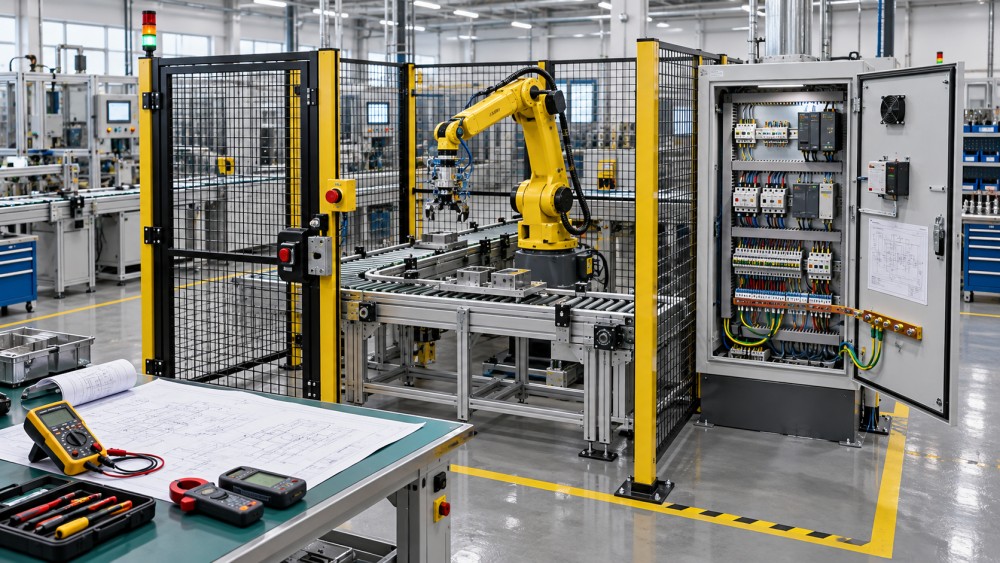
The integrated system assessment must address interactions. Opening an access gate may need to stop several machines, while stored pneumatic energy or a suspended load may remain hazardous after electrical power is removed. Restart behavior, operating modes, and maintenance access therefore matter as much as individual component approvals.
- Robot cells: ISO 10218 provides relevant robot and integration safety requirements. A collaborative robot is not automatically a safe collaborative application; tooling, workpieces, speeds, and possible contact must be assessed.
- Safety controls: ISO 13849-1 or IEC 62061 can support the design and validation of safety-related control functions. A certified controller alone does not prove that the complete safety function achieves its required performance.
- Laser equipment: Assess laser classification, accessible emissions, protective housings, interlocks, and market-specific obligations. US laser products may also face FDA/CDRH requirements separate from electrical approval.
- Wireless equipment: Check destination radio rules, including FCC requirements where applicable in the United States. A pre-approved module does not remove every host-product obligation, especially after antenna or integration changes.
- Hazardous locations: Equipment for explosive atmospheres needs a destination-appropriate approval strategy. ATEX and IECEx are not automatically interchangeable with every national hazardous-location approval.
Standards such as IEC 60204-1 can guide machine electrical design, while ISO 12100 supports machinery risk assessment. Standards are not themselves export certificates. Their legal status, edition, and acceptance depend on the jurisdiction and assessment route.
What documentation should be ready before shipping?
A certificate without a matching machine configuration is weak evidence. The technical package should identify the model, options, supply characteristics, intended use, and configuration actually assessed. Serial-number records or equivalent traceability help connect that evidence to the shipped equipment.
Prepare the documentation in layers so that operators receive usable instructions while the manufacturer retains the detailed evidence required by the applicable rules:
- Scope and responsibility: Equipment description, intended use, limits, interfaces, and the party responsible for final integration.
- Risk and design evidence: Risk assessment, electrical and pneumatic drawings, protective measures, safety-function specifications, and verification or validation records.
- Compliance evidence: Applicable legislation and standards, relevant test reports, certificates where required, and component approval records with their limitations.
- Market-facing documents: Required conformity or incorporation declarations, markings, instructions, and local-language safety information.
- Installation information: Supply requirements, grounding arrangements, protective-device requirements, environmental limits, and commissioning checks.
Not every internal technical record must travel with the machine or be handed to the purchaser. Distinguish documents that must accompany the equipment from records that must be retained and made available to authorities. Confirm retention and accessibility duties under the applicable legislation.
EMC evidence also needs to match the assembly. Cable routing, shielding, filters, grounding, and enclosure construction can change emissions and immunity performance. Reports for individual drives or controllers may support the assessment but do not automatically demonstrate compliance of the complete machine.
How can you avoid redesigning the machine after it arrives?
Settle the approval route before freezing the electrical architecture and purchasing long-lead components. Late changes are especially disruptive when they affect enclosure size, disconnect arrangements, protective devices, safety circuits, or the incoming supply.
- Define the destination and installation. Record the country, site, supply voltage and frequency, grounding system, environment, and special hazards.
- Classify the shipment. Distinguish a complete machine from partly completed machinery, a control panel, or components intended for later integration.
- Assign responsibility. Identify the manufacturer, importer, final integrator, and party handling local approval. Document who supplies each declaration and technical record.
- Agree on assessment scope. Where third-party involvement is needed, establish the standards, configuration, installation assumptions, and acceptance route with the relevant assessment body.
- Review the design before testing. Resolve component suitability, protection, safety architecture, markings, and documentation gaps while changes remain manageable.
- Control the shipped configuration. Record approved substitutions and evaluate whether software, tooling, or wiring changes require additional assessment.
Separate customs release from permission to install and operate. A shipment may clear the border while still lacking acceptable electrical approval, workplace safeguards, or site acceptance. Keep commercial documents, product-conformity evidence, and commissioning requirements as distinct workstreams.
Can one test report cover several models or destinations?
Sometimes, but only within a justified scope. A product-family assessment may cover defined variations when the differences do not invalidate the evidence. Higher power, different drives, longer cables, revised guarding, or changed safety software can require further review. The assessment body should confirm coverage where certification is involved.
International test evidence can reduce repeated work, but it does not create universal market access. For example, an IECEE CB report may support national certification for products and standards within that scheme, subject to national differences. It is not a blanket approval for an entire automated production line.
Do used or modified machines need another assessment?
Used equipment is not automatically exempt. A machine entering a market for the first time can face obligations different from those governing its previous domestic use. Existing markings and old reports need to be checked against the equipment’s condition, configuration, and applicable placement rules.
Modifications require a separate judgment. Replacing a component with an equivalent part is different from increasing operating speed, adding a robot, changing access protection, or rewriting safety logic. Assess whether the change creates new hazards, alters existing protective measures, or triggers new manufacturer obligations under local law. Resolve that question before treating the original conformity documents as sufficient.
Got questions about this industry report or seeking customized analysis for your specific sector? Drop us a line below, and let the research experts at Indu Horizon Report help you out.
We respect your privacy. Your information is strictly confidential.
Related News
- Can a process automation platform integrate with legacy systems?Nov 07, 2026Can a process automation platform integrate with legacy systems? Explore integration methods, security risks, and pilot strategies before you invest.
- How to evaluate a manufacturing digital transformation consulting firmNov 04, 2026Evaluate manufacturing digital transformation consulting firms with confidence. Compare delivery evidence, plant expertise, integration risks, costs, and measurable outcomes.
- What drives the cost of contract manufacturing services?Nov 03, 2026Explore what drives contract manufacturing services costs, from materials and tooling to logistics. Learn how to compare quotes and control total costs.