
Industrial Automation Costing: Which Lifecycle Costs Change the Payback?




The purchase price is usually the most visible line in an automation proposal, but it is rarely the cost that decides whether the project pays back. Industrial automation costing should start with the full operating life of the cell or line: the work required to make it production-ready, the cost of keeping it available, and the expense of adapting it when products, volumes, or processes change.
A lower-priced robot, CNC machine, laser system, or control platform can become the more expensive choice when it requires extensive custom engineering, produces fragile changeovers, or depends on scarce support. Conversely, a higher initial investment may be justified when it reduces labor exposure, stabilizes throughput, protects quality, and can be redeployed across future products. The evaluation should therefore focus on lifecycle costs that materially alter the payback period, not on a simplified equipment comparison.
Start with the cost of a working production system
Quoted equipment cost is not the same as installed system cost. A robot arm, machine tool, vision camera, or software license has no economic value until it performs the intended task at the required rate, quality level, and safety condition within the actual factory environment.
Integration is often the largest early-stage variable. It can include mechanical design, fixtures, grippers, guarding, material handling, PLC programming, robot programming, vision configuration, electrical work, safety validation, network connection, and factory acceptance activities. The more exceptions a process contains, the more integration effort it usually needs. Parts that arrive in inconsistent positions, require frequent manual judgment, or vary substantially between batches raise both the original integration cost and the cost of future adjustments.
Business cases become more reliable when the scope is divided into clear layers:
- Core equipment: robots, CNC systems, laser sources, conveyors, controls, sensors, and safety hardware.
- Application engineering: tooling, end-of-arm equipment, process development, cycle-time tuning, and quality validation.
- Plant readiness: power, compressed air, extraction, foundations, network infrastructure, material presentation, and floor-space changes.
- Commissioning: installation, testing, operator training, run-at-rate trials, and stabilization after handover.
A proposal that is vague about any of these layers is not necessarily unsuitable, but it should not be treated as a fixed-cost proposal. It is an early estimate with meaningful delivery risk.
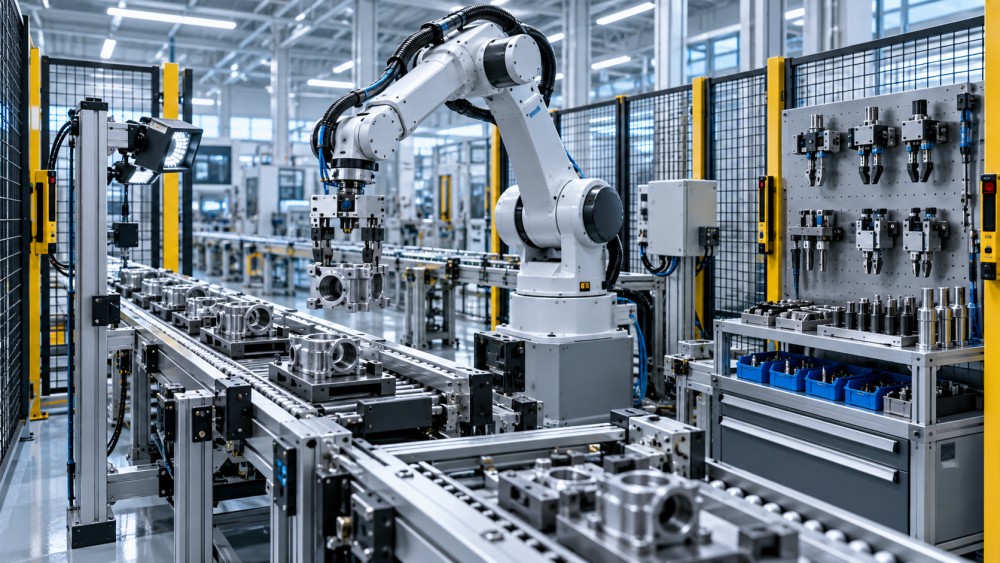
Integration complexity changes the economics more than headline cycle time
Cycle time matters, but only when it is sustained in ordinary operation. A system may demonstrate an impressive sequence using ideal parts and a controlled presentation method, then lose capacity when production introduces mixed batches, worn tooling, interrupted material supply, or recovery after a fault.
For costing purposes, distinguish between technical cycle time and effective production time. Technical cycle time measures how quickly the equipment performs its programmed sequence. Effective production time includes loading, unloads, inspections, replenishment, planned stops, recovery actions, and the small interruptions that accumulate across a shift.
This distinction is especially important for flexible manufacturing. A highly customized automated cell can be economical for a stable, high-volume product family. It becomes harder to justify where mix changes are frequent and every new variant needs an integrator visit. In that situation, modular fixtures, configurable grippers, accessible programming tools, and standardized interfaces may cost more upfront but reduce changeover and engineering spend over the system’s life.
Downtime cost is not just a maintenance issue
Unplanned downtime has a compounding effect. It can reduce output, create overtime, delay downstream work, increase expedited logistics, and force manual workarounds that undermine the original labor model. A line that depends on one automated station can be financially exposed even when the station itself is reliable, because no alternative route exists when it stops.
Evaluate downtime through the production consequences rather than a generic uptime assumption. Ask how the process recovers after a sensor fault, a dropped part, a vision mismatch, a tool wear alarm, or a rejected component. Can trained site personnel return the cell to operation? Is remote support available? Are critical spares held locally? Does the system preserve its process state, or does recovery require lengthy requalification?
Maintenance cost includes scheduled servicing, consumables, calibration, software backups, spare parts, and external service support. It also includes internal time: technicians diagnosing faults, operators waiting for assistance, and engineers managing recurring process instability. The lowest-maintenance system is not always the correct choice. A more advanced solution can be worth its service cost when it protects a high-value process or reduces quality escapes. The relevant question is whether maintenance requirements are predictable, resourced, and proportionate to the value of the output.
Energy, consumables, and facilities costs deserve process-level treatment
Energy is often assessed too broadly. The useful comparison is not simply which machine has the lower power rating, but how each option consumes energy across production, idle time, warm-up, standby, extraction, cooling, compressed air, and auxiliary handling. Laser processing, high-speed machining, thermal operations, and extensive pneumatic systems can have cost drivers outside the primary machine.
Consumables can be equally important. Depending on the application, this may include cutting tools, welding wire, shielding gas, abrasives, filters, lenses, nozzles, lubricants, cleaning materials, or replacement gripper surfaces. An automation project that increases throughput can also increase consumable usage. That is acceptable when margin and capacity improve, but the model should reflect the new operating pattern.
Labor savings should be modeled as capacity, not automatically as headcount reduction
Labor is commonly used to justify automation, yet direct labor savings are often overstated. Automation may remove repetitive handling from a process while creating demand for supervision, material replenishment, inspection, maintenance, programming, and production coordination. The financial benefit depends on what happens to the released labor capacity.
Where a site can redeploy people from a bottleneck, avoid overtime, cover difficult shifts, or increase output without proportional hiring, automation can create a strong business case. Where staffing cannot be reduced or redeployed and demand is flat, the labor component of payback is weaker. That does not mean the project has no value; quality consistency, ergonomics, traceability, delivery reliability, and reduced dependence on hard-to-fill roles may still be relevant. They should be described separately instead of being converted into unsupported labor savings.
Training belongs in the same discussion. Operators need to understand normal running and safe recovery. Maintenance teams need access to diagnostics, documentation, backups, and spare-parts information. Engineering teams need sufficient control of parameters and recipes to support product changes. A system that can only be altered by an external specialist may be appropriate for a highly controlled process, but the recurring support cost and response time must be included in the ownership model.
Software ownership and upgrade paths can become long-term constraints
Modern automation increasingly depends on software: robot programs, PLC logic, HMI screens, machine vision recipes, data collection, manufacturing execution connections, and digital-twin models. These tools can improve visibility and repeatability, but they can also create lock-in if ownership and access are unclear.
Before committing, establish who controls source files, parameter sets, backups, passwords, version history, and interface documentation. Clarify whether the site can make routine changes internally, whether licenses are perpetual or recurring, and what happens when a controller, operating system, camera, or industrial PC reaches end of life. These questions are less exciting than robot payload or laser power, but they frequently determine the real cost of maintaining a line for years.
For projects involving robotics, CNC, laser processing, and connected production systems, external market intelligence can also improve assumptions before a supplier shortlist is finalized. GIRA-Matrix tracks technology shifts and supply-chain conditions affecting areas such as motion control, vision, digital manufacturing, and automation components. That context is useful when estimating the exposure of a project to component availability, controller ecosystems, or a rapidly changing application technology.
Residual value is real, but flexibility is usually more valuable
Equipment resale value should not be ignored, particularly for standard robots, machine tools, and reusable peripherals. However, a highly customized cell may have limited value outside its original process. Fixtures, guarded layouts, bespoke handling mechanisms, and application-specific code are often difficult to transfer.
More important than resale is redeployment potential. Can the robot be moved to a related task? Can the vision system be retaught? Can fixtures be replaced without rebuilding the cell? Can the conveyor and safety architecture support another product family? A system designed around standardized components and documented interfaces can retain strategic value even when the original product changes.
Build the payback case with scenarios, not one confident number
A single payback figure can hide the assumptions that matter. A stronger investment case uses a base case plus at least two operational scenarios: one where demand, availability, and changeovers perform as expected; one where ramp-up takes longer or disruptions are more frequent; and one where the equipment supports additional volume, a second shift, or a related product family.
The purpose is not to make the project look less attractive. It is to identify which assumptions drive the decision. If the result only works under perfect uptime and immediate labor removal, the project needs redesign or a different commercial structure. If it remains viable when commissioning takes longer and maintenance is higher than planned, the case is more resilient.
Before approval, ask suppliers and internal stakeholders to align on five practical items: the definition of productive output, the boundaries of integration scope, the expected recovery process for common faults, the cost and ownership of future changes, and the operational team responsible after handover. Those answers will usually improve industrial automation costing more than another round of equipment-price negotiation.
Got questions about this industry report or seeking customized analysis for your specific sector? Drop us a line below, and let the research experts at Indu Horizon Report help you out.
We respect your privacy. Your information is strictly confidential.
Related News
- Can a process automation platform integrate with legacy systems?Nov 07, 2026Can a process automation platform integrate with legacy systems? Explore integration methods, security risks, and pilot strategies before you invest.
- How to evaluate a manufacturing digital transformation consulting firmNov 04, 2026Evaluate manufacturing digital transformation consulting firms with confidence. Compare delivery evidence, plant expertise, integration risks, costs, and measurable outcomes.
- What drives the cost of contract manufacturing services?Nov 03, 2026Explore what drives contract manufacturing services costs, from materials and tooling to logistics. Learn how to compare quotes and control total costs.